
Contributors to Team Indus project will have names etched on an object going to space.

The images show VELC (Visible Emission Line Coronagraph) and SUIT (Solar Ultraviolet Imager) instruments as seen by the camera on-board Aditya-L1 on September 4, 2023.

Its duties include experiments to further understand the lunar surface.

With an instrument on board India's lunar mission Chandryaan discovering water molecules on the Moon, scientists are now confident of harvesting water from the lunar surface in the future, which could help sustain lunar astronauts and even propel missions to Mars.

Fifty years ago on July 20, 1969 with these words American astronauts Neil Armstrong, Michael Collins, and Edwin "Buzz" E Aldrin made history by becoming the first human beings to set foot on another world -- the moon. It was an event that was watched by millions on television and one that remains etched in all our memories. Collected here are 17 images of that historic mission, a "giant leap for mankind".

Foreign Office spokesperson Mumtaz Zahra Baloch during her briefing on Friday was asked to comment on the successful soft-landing of the Chandrayaan-3 mission on the Moon.

ISRO Chairman S Somanath had recently said the most critical part of the landing will be the process of reducing the velocity of the lander from 30 km height to the final landing, and the ability to reorient the spacecraft from horizontal to vertical direction. "This is the trick we have to play here," he said.
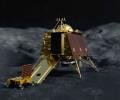
The Lander and the Rover have scientific payloads to carry out experiments on the lunar surface. The main function of the Propulsion Module (PM) was to carry the Lander Module (LM) from the launch vehicle injection till final lunar 100 km circular polar orbit and separate the LM from PM, which it did.

'This may open up doors for private players in India to collaborate with global players in commercial missions.'

Hours before Chandrayaan-2's 'Vikram' module's proposed soft landing on the Lunar surface, Indian Space Research Organisation chairman K Sivan said on Friday things are progressing as per plan for the much-awaited event.

XPoSat or X-ray Polarimeter Satellite is India's first dedicated polarimetry mission to study various dynamics of bright astronomical X-ray sources in extreme conditions.
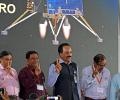
Ex-ISRO chairman G Madhavan Nair said the scientists at space agency have achieved this historic success by getting a salary one-fifth of the scientists in the developed world.

The entire mission operations of Chandrayaan-3, right from the launch till landing, "happened flawlessly" as per the timeline, the team that led India's third mission to the Moon said on Wednesday.
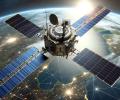
India is marching towards becoming the fourth country in the world to have space docking technology.
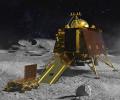
ISRO chairman K Sivan said the proposed soft-landing was going to be a 'terrifying' moment.

The Artemis I flight test is an uncrewed mission around the Moon that will pave the way for a crewed flight test and future human lunar exploration as part of Artemis.
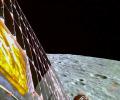
As scientists at the Indian Space Research Organisation (ISRO) gear up for the much-awaited soft landing of the Chandrayaan-3 spacecraft on the Moon's surface, the space agency may postpone the touchdown to August 27 in the event that health parameters of the lander module are found to be "abnormal", a senior official has said.

Group Captain Shubhanshu Shukla Shukla says Wing Commander Rakesh Sharma -- the first Indian to travel to space --has been advising him about the space flight.
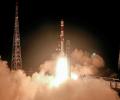
The Indian government has approved the construction of a third launch pad at Sriharikota, capable of sending heavier spacecraft into orbit. This new facility will support India's ambitious space program, including the Gaganyaan human spaceflight mission and a lunar landing. The launch pad will be built at the Satish Dhawan Space Centre and is expected to be operational within four years.

Friday's mission is the fourth operational flight of LVM3 which aims to launch the Chandrayaan-3 spacecraft into a Geo Transfer Orbit.
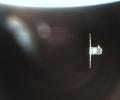
The Indian Space Research Organisation (ISRO) has successfully performed the docking of satellites as part of the Space Docking Experiment (SpaDeX). The docking was achieved after a series of maneuvers, including a trial attempt on January 12. The SpaDeX mission, launched on December 30, 2024, aims to demonstrate in-space docking technology using two small spacecraft. This technology is crucial for achieving complex mission objectives that require multiple rocket launches.

A satellite placed in the halo orbit around the first Lagrangian point (L1) of the Sun-Earth system has the major advantage of continuously viewing the Sun without any occultation/eclipses, the IIA said.
India's first mission to Moon -- Chandrayan-I -- is tentatively scheduled to be launched on September 19 this year, Indian Space Research Organisation Chairman Madhavan Nair said. He said that all the preparations have been nearly completed and the exact date of the launch will be decided within a month. He described September 19 as the 'earliest opportunity' for the historic launch. The final stage of integration of instruments with the spacecraft was going on.
Sony World Photography Awards 2025 Winners Announced
The Indian Space and Research Organisation (ISRO) will launch two initial missions later this year under the Gaganyaan programme, followed by country's maiden human space-flight mission in 2024, Union Minister Jitendra Singh has said.

China's President Xi Jinping congratulated scientists on the complete success of the Chang'e-5 mission.

Narayanan has a long and distinguished career at ISRO, having played a key role in several important missions, including Chandrayaan-2 and 3, and the Gaganyaan programme.

'Today onwards, the onboard thrusters will be fired and Chandryaan-3 will be taken away from Earth for an eventful landing on Moon's surface on August 23'

While the actor did not specify the man in the cartoon, many social media users slammed the actor for making fun of former Indian Space Research Organisation chief K Sivan.

On October 3, Subramanian, a Chennai-based mechanical engineer, had tagged the Twitter handles of NASA, LRO and ISRO in a tweet, asking, "Is this Vikram lander? (1 km from the landing spot) Lander might have been buried in Lunar sand?"

The Rs 978 crore mission, which has been rescheduled for Monday after scientists corrected the glitch in the rocket, will be launched at 2.43 p.m from the second launchpad at Satish Dhawan Space Centre, over 100 km from Chennai.

As India's first solar exploration satellite reached space, four Kerala public sector undertakings, including Keltron, have reason to be delighted as they too have contributed to this achievement by the country. Various products indigenously developed and manufactured by the four PSUs - Keltron, Steel and Industrial Forgings Limited (SIFL), Travancore Cochin Chemicals (TCC) and Kerala Automobiles Ltd (KAL) - have been used in the Aditya L1 mission. This milestone achieved by the PSUs was highlighted by state Industries Minister P Rajeev in a Facebook post.
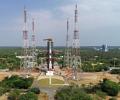
Days after landing on the Moon, India will aim for the Sun on Saturday with its maiden solar expedition, as ISRO's trusted PSLV will carry the Aditya L1 mission on a 125-day voyage to the Sun.

We had asked readers to greet ISRO on the stupendous achievement of landing on the Moon, and they were prompt in celebrating ISRO's, and India's, success.

The Indian Space Research Organisation (ISRO) on Thursday announced that its lunar mission Chandrayaan-3 will be launched on July 14 from the space port at Sriharikota in Andhra Pradesh.

The first test-flight will be followed by sending a female-looking spacefaring humanoid robot -- Vyom Mitra -- in outer space likely next year.

Chandrayaan-2 was launched on July 22, 2019 and inserted into the lunar orbit on August 20, exactly one year ago.

Beresheet was developed by SpaceIL and Israel Aerospace Industries. If the mission had been completed successfully, Israel would have been the fourth country, after the Soviet Union, the United States and China, to land a spacecraft on the moon.
"On space, we will be able to announce that India is signing the Artemis Accords, which advance a common vision for space exploration for the benefit of all humankind," a senior administration official said hours before the meeting between Prime Minister Narendra Modi and President Joe Biden in the Oval Office.
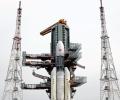
The Indian Space Research Organisation said that the countdown started at 6.51 am on Sunday.
 © 2026 Rediff.com - Advertise with us - Disclaimer - Privacy Policy - Sitemap - Feedback - About us - Terms of use - Grievances